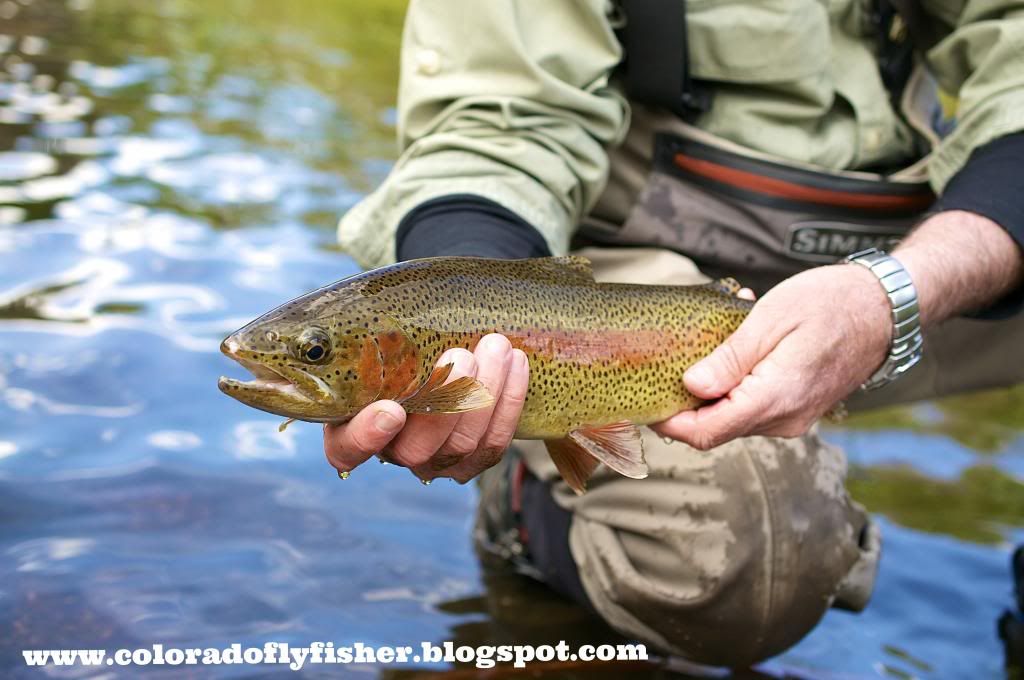
Gazette Article - How To Properly Handle Trout!

Sunday, February 13, 2011

Life Lessons Learned Through Fly Fishing


I need to make decisions. The perfect cast is like making the right decision, but does that cast always catch the fish? Making a thousand casts off target and slapping the water is a metaphor for making the same mistakes and always getting the same results, which is never the desired one (no fish). Everyone that makes the perfect cast has at some point worked to achieve said cast and will reap the rewards.

But what is that reward? The catch right? What about the feeling you get when you become aware of the hard work you put in combined with a sense of accomplishment? To me there is no greater feeling than when you've worked hard to reach a goal and after the goal is reached realizing your really damn proud of yourself for the hard work you put in, and the trophy itself is nothing more than a reminder of your hard work. This very ideal is why we get bored doing things that are too easy no matter how great the trophy, and the challenges fishing and life present are in fact so challenging that it keeps us coming back for more.

We meaning anyone with a heart and the strength to take the abuse. But life's not just about making the perfect cast. Now its time to make our fly selection. One of my biggest challenges on life's river has been knowing how to stay true to myself and yet still feed the trout in the river what they want to eat. In other words how do I do what I want, and feed other people what they want so we are mutually happy? Truth be told to catch fish you have to feed them what the they want even if you don't like it, but you catch fish which in turn brings you happiness.


The reverse to that would be me on life's river, and I don't care what the fish want because I'm going to force feed them this size 12 Elk Hair Caddis when they really want a size 24 midge. The fact is a few of these stubborn trout might go for a big unnatural looking Elk Hair, but most of the time your going to get skunked which is never a happy feeling no matter how many perfect casts you make. This midge also has to be presented in a way that will entice the take. People don't like being charity cases and there are a million other reasons fish wont take the bait. But if your hearts into making the right fly selection and you achieve a perfect drift and perfect presentation then there isn't a fish in the water you cant catch.


Life is a give and take battle just like playing a big brown on 6x tippet. Balance equals opportunity. You have to balance the times you can take line with the times the fish wants to do the same. If your goal is to land the fish then patience and balance are required along with a willingness to let line go. Horse that big catch and your connection breaks. You know the funny thing about advice though is that anyone can give it and no one is ever perfect enough to always follow it. Believe me when I tell you that I am always having to correct my cast and I've tried to force feed many trout that weren't interested. Truth be told I wrote this more to help myself which got me wondering about all those self help gurus out there?


I was on a recent trip and the bite had died as the sun was going down, and being out there under that insane beautiful Colorado sunset got me thinking about life. As I stood there I suddenly realized that all that there is to learn about life I had been learning and practicing through fly fishing with out ever being aware of that fact. I've never been a really religious person in the traditional sense but I felt compelled after I collected my thoughts to just pray and thank God for all that is positive and beautiful in life. Things that we all take for granted, and if there was ever proof that there is a divine creator all we need to do is stop harassing the fish long enough to look at our surroundings. Ultimately I hope that at some point and time someone reads this and it gets them thinking as I did, and as you drift through your own life's rivers you find happiness through hard work and fishing for your life's catches. Be steady wading through turbulent waters and enjoy sunsets. Tight Lines!


Tuesday, January 25, 2011

Barr's Bouface

I was tying these in the shop yesterday and was proud of my work so I felt inspired to take this pic.


Monday, January 17, 2011

Tailwater Fly Fishing

When I think of tailwater fly fishing I picture rocky canyons, big fish, small flies and cold winters.  A tailwater is anywhere a river comes out beneath a bottom-release dam.  Rivers like the South Platte can have several lakes or reservoirs along its drainage, all of which can provide very different fly fishing experiences. 

  Photo by Jon Kleis
During the peak of winter, most lakes and reservoirs only have a few feet of ice on the surface. This means that the water coming out below the dam can be a few degrees above freezing, even during Janurary. The water conditions this time of year are low and clear, but the fishing can be very productive if you manage to get on the water during a warm day with a good hatch.  Colder temperatures limit the type of bugs that can hatch, which makes fly selection simple.  Fly selection is limited to small baetis (bwos) on the overcast days from October-December and March-June, and extremely small midges.

Good winter patterns are: Kleis's Mid-Drift Midge size 22, gray RS-2s size 22-24, Dorsey's Top Secret midge size 22-24, Black Beauties size 22-26, Parachute Adams size 24-26, Apricot Glow Bugs size 16, San Juan worms size 16, and for some tailwaters, Mysis Shrimp patterns like Sand's Epoxy Mysis size's 16-18.   


Kleis's Mid-Drift Midge in Olive

Tailwaters also provide great fishing opportunities in the summer months, and in states that normally would'nt have water cold enough to hold trout. During the summer, water at the bottom of these reservoirs stays cooler because of the lack of exposure to sunlight.  Rest assured, if there is a bottom-release reservoir -even in states as hot as Texas- the odds are good that at least part of the year the river below holds trout.


As far as insects go, the bugs that can be found are as diverse as the types of tailwaters they live in.  Even during winter there are more than just midges and baetis available.  There are also stonefly nymphs, caddis larvae, annelids, crane fly larvae, leeches, and terrestrials such as scuds and crawfish. Baetis, midges, and small stoneflies are typically the only two insects that are comfortable hatching in temps associated with winter fishing, so that is what the trout focus on. Stonefly nymphs don't go through an emergence stage like a mayfly nymph, so unless there are a ton of stonefly nymphs on the move, trout might not be conditioned to seeing and eating them. Trout have to see the bug in order to eat the bug. Try using a small stonefly pattern as your lead fly on a 2 fly nymph rig, but if you see it spooking trout, or that it's not producing, switch to 22's-26's. 

Stonefly found during winter photo by Jon Kleis


In the spring fish are looking up for caddis and baetis that are either emerging, or resting on the surface as adults. Fish also move into shallower and faster feeding lanes as a result of run-off, and the rainbow/cutthroat spawn. 


Avoid casting to fish that you can tell are actively spawning on a gravel bed. Instead, target the back of spawning beds in an attempt to pick up fish that are feeding on eggs. Because trout spawn, or stage in shallow and well oxygenated water, my strike indicator is set shallow so I don't drag on the bottom. This increases my chances of detecting a strike sooner, and reduces my chances of foul hooking fish. 

You will know after a few casts if a fish is feeding, or has something else on its mind. Land the fish as quickly as possible and handle the fish as little as possible. Always keep the fish and the net in the water after landing your catch. Another great way to fish the spawn is to find fish as they migrate.  Migrating fish are eager takers and are still exposed in fast, and shallow water.

Starting in late-spring/early-summer a good all around PMD nymph imitation to use is the Pheasant Tail nymph.  A good way to fish when trout aren't actively feeding on the surface is to use a tandem nymph rig under a strike indicator.  I like to use a Pheasant Tail as my first fly, and with 5x tippet tie about a 15 inch section of leader material from the bend of the Pheasant Tail hook to a size 22 or smaller gray RS-2.  Roughly 8-10 inches in front of the Pheasant Tail clamp a #1 or #4 split shot to help your flies get down.  

Adjust your indicator according to the depth of the water your fishing in, so you're presenting your flies to the fish in their feeding zone where they can see it.  Now you're covering two bases (PMDs and BWOs) which doubles your odds of fooling different fish that could be focusing on two completely different hatches.  Make sure to check with your states regulations before you fish tandem rigs because its illegal in some states.

Photo by Daniel Zimmerman

Early Summer means fish are now looking up for sparse caddis hatches along with stoneflies such as the Yellow Sally Stonefly, as well as emerging and adult PMDs.  Good dry fly imitations for stonefly hatches are the Headlight Yellow Sally, and Stimulators.  Fish are also looking for terrestrials like hoppers, ants, and beatles.  As far as nymphs are concerned, try a Lafontaine's Sparkle Pupa behind a tan-colored San Juan worm.  Late summer signals the start of the Trico mayfly hatch in many tailwaters.  Depending on the river and it's biomass, the trico hatch itself can be huge, and trout feed like ravenous sharks as the bugs die and fall to the water in what's called a "spinner fall."

Late summer and fall is by far my favorite time of year to fish.  In the morning, anglers are casting small trico dry flies.  Midday, have on some form of bouyant hopper with a drowned trico or small black RS-2 as a dropper.  During the afternoon/evening, caddis and sparse baetis hatches are back on the menu.  In my humble opinion, outside of the Mother's Day Caddis hatch, fall is the best time of year to fish with dry flies.


As the water cools and the days shorten, brown trout are staging to spawn, making them accessible to anglers.  Land-locked Sockeye salmon called Kokanee start their spawning migration, also.  Egg patterns, Copper Johns, and small olive baetis droppers are great flies to use in tandem if you decide to fish close to the bottom.

Tailwaters are so loaded with bugs and nutrients trout can grow up to 2-6 inches per year depending on the amount of fishing pressure, size of the river, and how much protein-rich food they have access to.  Some rivers have an abundance of shrimp such as the Mysis or Scud Shrimp and when trout key in on these two freshwater crustaceans they grow even faster, and have the most amazingly vibrant colors found on trout anywhere in the world.


Elevenmile Canyon photo by Daniel Zimmerman
Huge trout and scenery like this are what keeps most anglers coming back to these fisheries.  If I had to choose one type of water to spend my entire life fishing, forsaking all others, it would be a tailwater.  This is a place where you can challenge yourself to become a better angler, and have a chance to land the fish of a lifetime.  To request a guided trip with me on the South Platte shoot me an email to jonkleisflyfishing@yahoo.com


Wednesday, January 12, 2011

A Breath Of Fresh Water Part 2

Pat's Rubber leg photo by Jon Kleis
Large stoneflies are in the river system year around and good nymph imitations are Prince nymphs or a Pat's Rubber Leg nymph.  Again when Im fishing these patterns it is usually during the warmer months or higher flows and Im typically looking for actively feeding fish in faster pocket water or I am dredging the bottom of deeper pools with a lot of weight on my leader in order to get down to bigger fish.  I haven't personally seen an actual stonefly hatch but it doesn't hurt to have adult imitations of the bug.  Good Patterns for adult "stone's" are Amy's Ants or Stimulator's.
Yellow Stimulator photo by Jon Kleis


The warmer months are great for wet wading.  Waders are awesome for keeping you warm and dry, but when the high temperature for the day is in the nineties it feels great to walk around in a pair of shorts with an old pair of tennis shoes or a good pair of wet wading shoes and stand in the river to keep cool.  When your wading be careful during higher flows.  Last year during spring run-off Deckers got well over a thousand c.f.s. (cubic feet per second) which is a very dangerous flow to wade and makes fishing a lot tougher as well.  Fish tend to stay close to the banks or they hang out in front of boulders where there is breaking water during high flows and playing a fish in fast water under those conditions with light leaders and tippet and small flies doesn't usually spell success.

Cheesman Canyon above Decker's photo by Daniel Zimmerman
Ideal flows for this region are from 150 c.f.s. to 250 c.f.s.  For stream flow reports go to the Colorado Division of Water Resources at http://www.dwr.state.co.us/SurfaceWater/Default.aspx.  As for gear during chilly conditions when its important to stay dry Simms sells quality breathable waders made with layered Gore-Tex that come with a great warranty and are extremely durable.  Orvis also has a new boot foot wader that has a cleated Bog boot that will keep winter anglers warm and dry.  Bring a 9 ft. 5 weight fly rod and 9 ft. 5x and 6x leaders and tippet and some split shot.

Flies to have in your box are: Elk Hair caddis size 14-18, Barr's Graphic caddis size 16-18, Buckskin's size 18-20, Pat's rubber leg size 10, various Stimulator's, Prince nymphs size 12-16, Apricot eggs size 16-18, San juan worms size12-16, Pheasant tail's size 18-22,  RS-2's in black and gray size 20-24, South Platte Brassie's size 20-24, Murphy's Bubbleback Midge size 22, Kleis's Mojo midge size 22, Parachute adam's size 20-26, Olive and Black Slumpbusters.

If you have any questions on this stretch of river or you need directions email me at jonkleisflyfishing@yahoo or go to anglerscovey.com or stop by the Anglers Covey fly shop and talk to myself (Jon Kleis) or any one of our knowledgeable staff.  We are located on the corner of highway 24 and 21st street on the right hand side if your heading towards the mountain.  Tight lines!  

Jon Kleis


Contact Form

Name

Email *

Message *