Gazette Article - How To Properly Handle Trout!

Showing posts with label Education. Show all posts

Thursday, October 20, 2011

Escaping The Crowds In The Fall

Fall in Colorado means you can count on beautiful scenery, unpredictable weather, and new residents waiting for the snow to fly before buying a good set of tires -resulting in extremely spooky entertainment just in time for Halloween...  As we dress up like monsters and go trick-or-treating, our rivers and lakes swell with genuine monsters looking for a "bite" to eat.  I say genuine monsters, because many of these fish seem to have come out of a twilight zone esq worm hole that we can only guess exists without any living proof -except for the occasional Nessy sighting.


Monster in size and stature fall fish are toothy and colorful, boasting vibrant shades of red, yellow, and brown.  The best part about fall fishing is that, with a few exceptions, you don't have to worry about crowds.  I say with a few exceptions because the South Platte river gets hammered with fishing pressure.  One stretch in particular gets more pressure than the others, and that is the South Platte below Spinney reservoir affectionately referred to as the "Dream Stream".  If you're not a fan of combat fishing (a.k.a. fighting through crowds of people in an attempt to get on a good spot) then you might consider the Dream Stream to be more of a nightmare during the spring and fall.
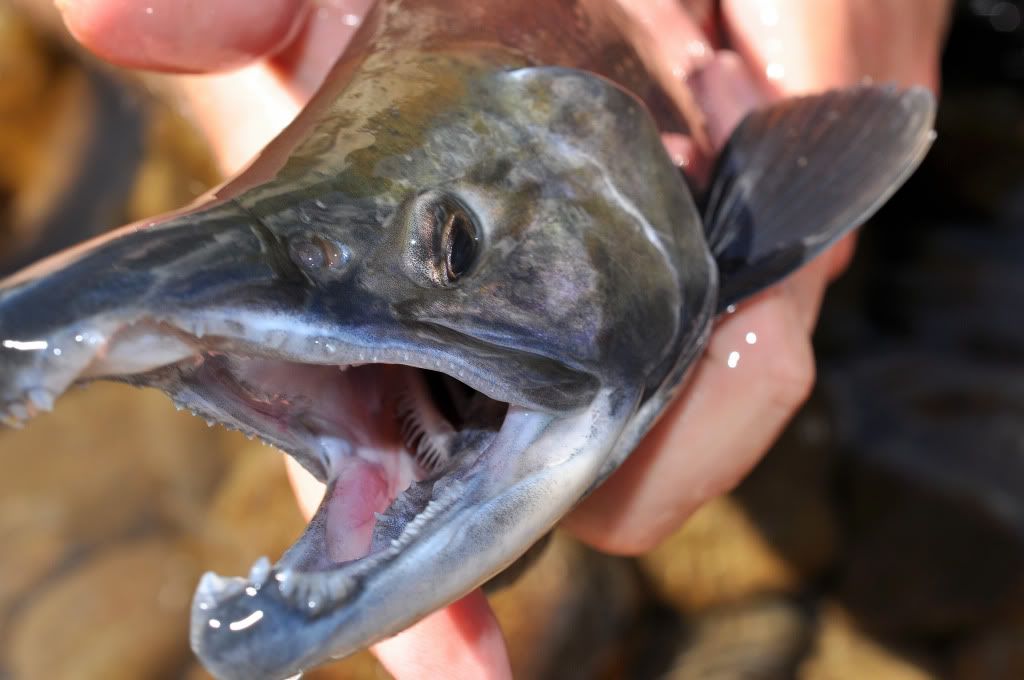

Brown Trout and Kokanee Salmon are fall spawners, and as many of you know, 11mile Reservoir is home to some insanely huge trout and a population of Kokanee, many of which migrate up the South Platte River below Spinney to spawn.  It goes without question, that when brown trout migrate to spawn, they are the most accessible, and that gives us as anglers the best chance to catch trophy fish.  Spinney Ranch is an amazing place, but I think many people miss out on great opportunities fall fishing in Colorado provides us.


I have two huge pet peeves as a professional guide and angler.  First, is when people talk poorly about other people who fish the Dream Stream this time of year. Yes, I understand the frustration that comes from seeing the "Dream" so crowded during the spawn. Consider that if you catch a Brook trout, Brown trout, Mackinaw, or a confused Cutthroat trout anywhere else in Colorado this time of year the odds are good you're harrassing a spawning fish, and that includes most lakes and reservoirs. My second pet peeve is when people think that the only two places you can consistently catch big fish in the fall are the Dream Stream or Taylor rivers. There are trophy fish all over Colorado, and October is a great month to get out and look for them.
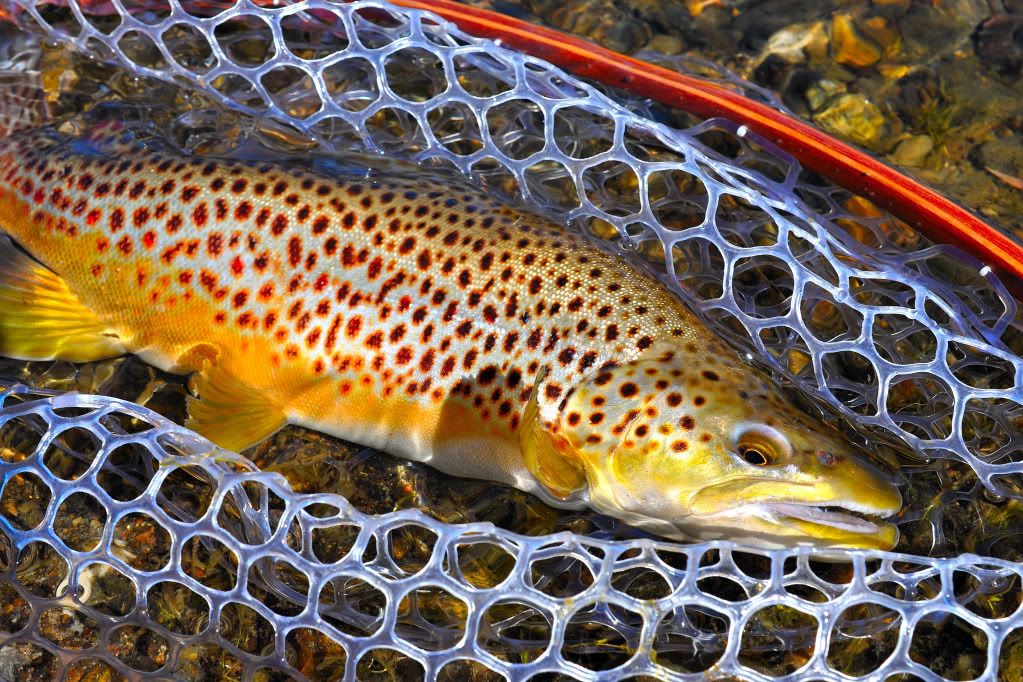
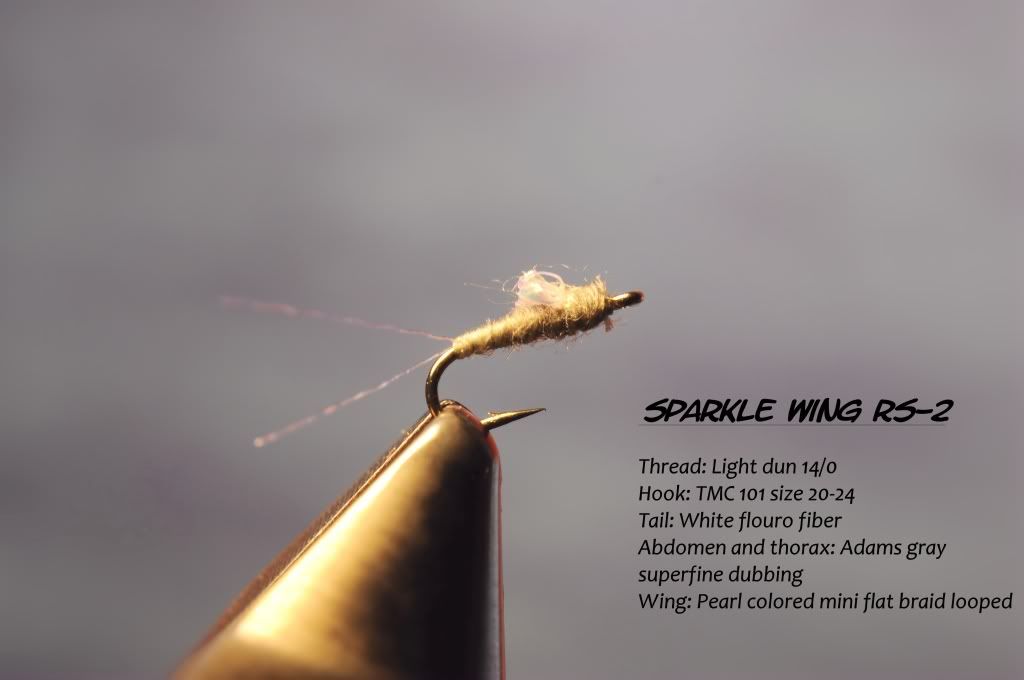


The Arkansas River below Pueblo dam is another great place to fish in the fall if you're trying to escape the crowds. The Nature Center and the Valco Ponds areas are the most popular places and seem to be the most productive. Click here to view map of the Valco Ponds area. This place gets a ton of fishing pressure in the winter because of pueblo's slightly warmer climate, but during the fall you'll be lucky to see another angler all day. If you're after big browns the nature center area is the place to be. White streamers are still on the menu here. Anglers looking to throw tandem nymph rigs should use Baetis emergers such as gray Sparkle wing RS-2's in a size 22, and any kind of small red or black midge are used as your dropper.


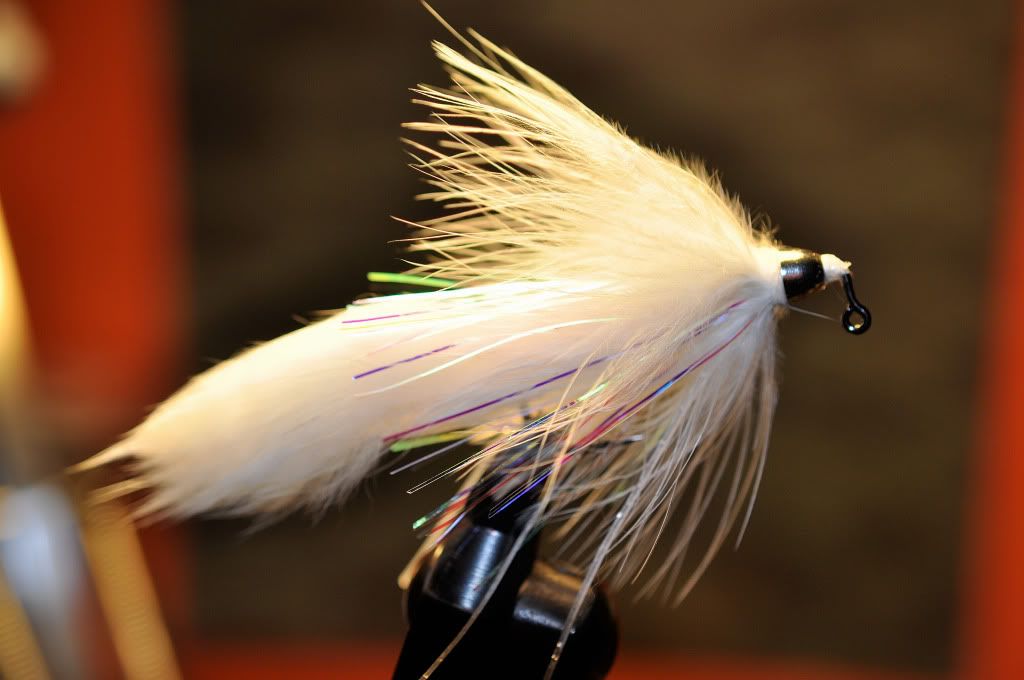
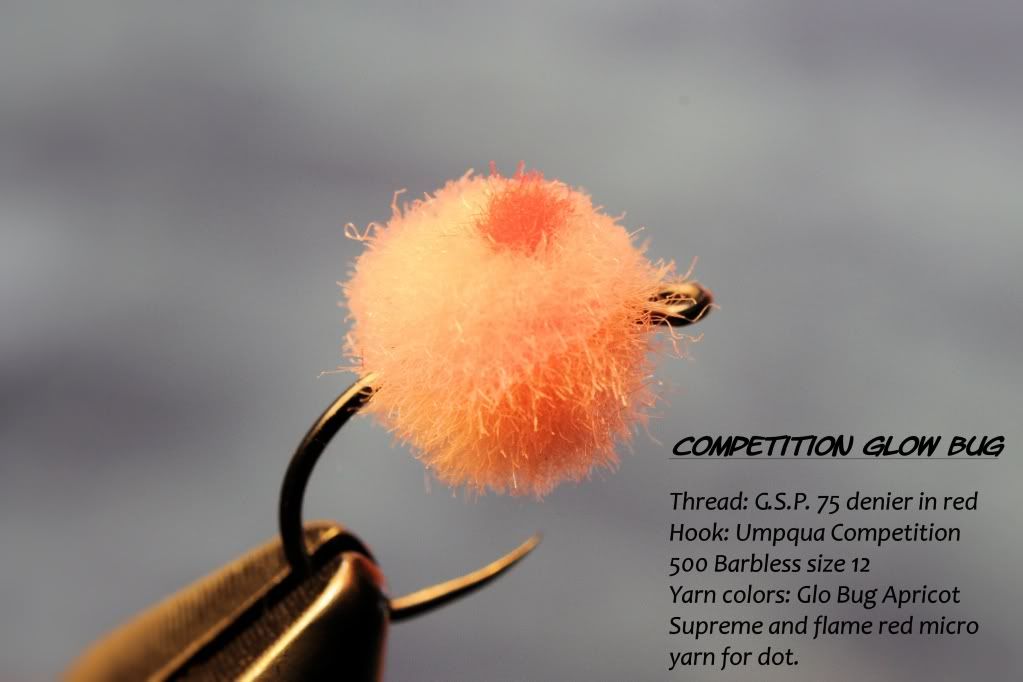
Tyers click on the photos to enlarge and see recipe.
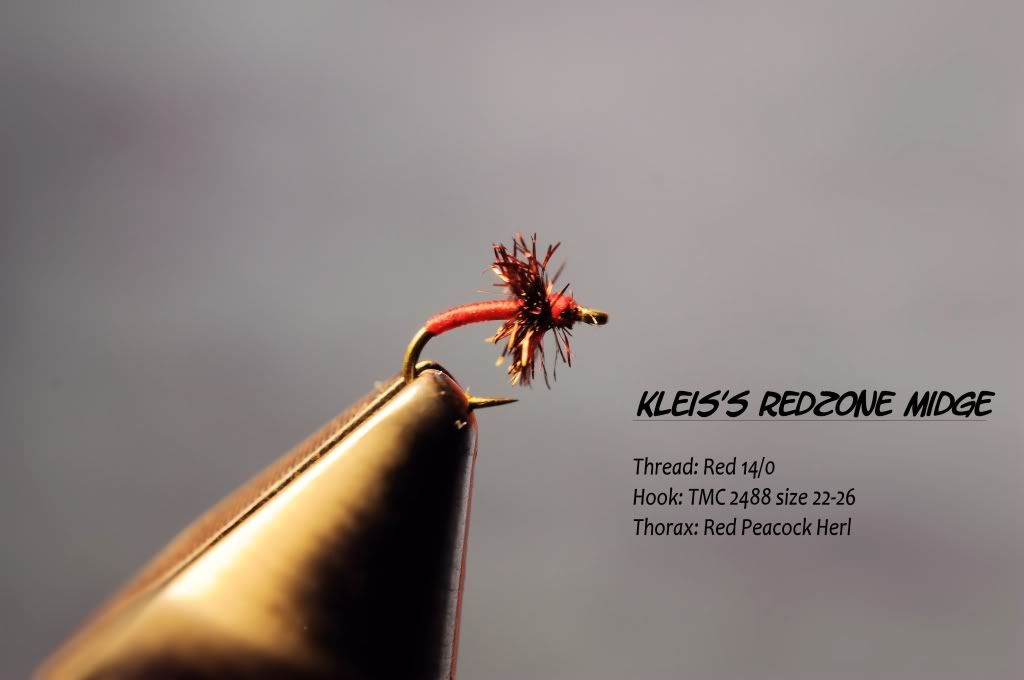


Rampart Reservoir is a short thirty-five minute drive from Colorado Springs and is a great place to fish for fall spawning Lake Trout a.k.a. Mackinaw.   "Lakers" as they are sometimes referred to, prefer cooler water temps.  Because water gets cooler the further down you get in the water column Lake trout spend most their lives at a depth of forty to sixty feet where they are comfortable.  As the water temperature drops in the fall, these fish that can weigh up to 60 lbs, move shallow to spawn.


Lake trout were stocked in Rampart to control the sucker population which they do well. They also seem to put a dent in the trout population wherever they are stocked; there's an ongoing joke in places like Rampart that when the stocking truck comes they're ringing the dinner bell.  Spring after ice-off, and in the fall before the freeze are the best times to fish from shore.  I can't begin to tell you how fun it is to strip huge streamers to huge fish. If you need proof, then pay close enough attention, and you will see that there is an ever growing cult of guys that only fish this way.   Throw white streamers and orange egg patterns at these extremely aggresive fish.  Meat Whistles, Zuddlers, and the Striptease are great streamer patterns to have in your box.


Tyers click to enlarge and see recipe


These are only a few of my favorite places you can go, where the fishing is absolutely epic in the fall, and crowding is at a minimum.  If you're interested in more fishing destinations to escape, here is my short list of the many places that seem to fade into the mist during fall:

Tomahawk SWA
Badger Basin SWA
Brush Hollow Reservoir
Monument Reservoir
Rosemont Reservoir
Tarryall Creek Below Tarryall Reservoir
Cheesman Canyon
Almost the entire Arkansas River
Nichols Reservoir
Beaver Creek below Skaguay Reservoir
Antero Reservoir

Saturday, October 8, 2011

How To Find Kokanee Salmon

Here is a short video on what to look for when you're searching for kokes.  The techniques I talk about in this video as far as what to look for hold true in just about any river situation including the South Platte (without the obvious features of a freestone river).  When you are looking for salmon on the Platte you can still find them by looking for hints of red against dark bottoms.  Most of the time they will be close to some form of structure that makes them comfortable and in deep runs. 


   Here is the direct link to this video so you can watch it in full screen HD on my youtube channel
                                               http://www.youtube.com/coloradoflyfisher


...

Friday, August 12, 2011

Kleis's Back To Basics "Bug Parts - The Adult Mayfly"

Ive decided to write several short articles aimed at helping people that are new to the sport better understand what everyone else is talking about.  There is so much hidden meaning behind what anglers say amongst each other and in the shop, as well as more acronyms than I think even the most experienced angler could remember in a lifetime so this is my attempt to help people just getting into the sport get caught up to speed.


This segment called "Bug Parts" is for new tyers.  When tying flies you hear people referring to what materials they used for the various parts of the bug they are tying.  For instance, "I used black fine and dry dubbing for the Trico's thorax".  For the second year tyer that might make perfect sense but for the rest of the human population what does that mean?


Photo and fly by Jon Kleis
Mayflies in both their nymph and adult stage's are divided into several different parts.  We will start with the adult mayfly.  The first and most obvious part is the tail which is followed by the abdomen.  The abdomen on the fly pictured is tied with black thread and a crystal flash overbody that is wrapped forward (wrapping a material forward is sometimes refered to as palmering or palmered) around the hook shank.  The second obvious part of this imitation of an adult Trico is the wing which in this case is tied with white Antron yarn and is laid out on either side and imitates a spent spinner.  The thorax is just behind the head of the fly where the wing connects and is the thickest part of the bug and is tied with thread for this example.   And of course the head of the fly is where you finished your bug and tied off your thread using a whip finish knot.


Click on photo to enlarge for a better view
This next photo is of a natural Trico spent spinner.  Adult mayflies become "spinners" when they mate and lay their eggs.  The mating ritual is towards the end of the mayflies life cycle.  After they lay their eggs they fall to the water from exhaustion in what we refer to as the "Spinner Fall" and then die.  The aerial dance combined with how the bugs look as they fall to the water to deposit eggs and die is how this stage of the hatch was named.  If a fly is tied like the one I made in the above photo with the wings splayed out to the sides it is refered to as a spinner.


Here is another example of a spinner.  Can you correctly identify the parts of this bug and what materials were used to tie each part?


Before Mayflies become spinners they emerge to become Duns which is the first adult stage of the bug after it has emerged and is free of its nymphal shuck.  The Dun trico has a short tail and tends to be a light olive or tan color instead of black like you see on a spinner, even though my favorite fly to fish all the way through the trico hatch from start to finish is the John Barr pattern called the Viz-a-dun and is black in color.  Duns also have strong wings that stand mostly upright.  The parts of the Dun as it pertains to tying are refered to using the same terminology as a spinner (tail, abdomen,wing, thorax).  Just be aware that there are different colors and traits such as the upright wing that you are imitating while sitting at your vice tying duns.


Click on photo for enlarged view of this Parachute Adams
The parachute adams is one of my favorite bugs to use when I know Baetis (also called the Blue Winged Olive, or B.W.O.) are emerging.   Around March on the South Platte River you will see tiny blue gray Baetis hatching starting at mid day.  Parachute flies are tied by anchoring your wing material (in this case white calf body hair) so thats it's facing up at a 90 degree angle.  Your hackle which normally forms your dry fly's thorax  is now being wrapped or palmered around the base of the upright wing to form a "parachute".  What is great about tying parachutes to imitate duns is that they have the upright wing and they also sit low on the surface film like the naturals would right after they emerge. 


Barr's Viz-a-dun Trico.  Notice the hackle is palmered around the hook to
form the thorax?  This is how it's done on most traditional dry flies tied with
hackle.


If there is anything I want you guys to take away from this read it is to have a better understanding of the four major parts of an adult mayfly pattern and also a clear understanding of what a parachute fly looks like and its benefits.  A really good book to purchase for tying mayflies is the late Shane Stalcup's book called "Mayflies Top To Bottom".  Also Ed Engle has a great book out that will help you get started tying those really tiny bugs for these technical Colorado tailwaters called "Tying Small Flies".  Both books are more advanced but still have helpful information for beginners. If you have enjoyed reading this post or my blog in general help keep it going by clicking the join this site button and subscribing!

To book me for a trip on the South Platte river shoot me an email at jonkleisflyfishing@yahoo.com

Thanks again and tight lines!


Wednesday, June 15, 2011

A Breath Of Fresh Water

The South Platte River is an amazing fishery with great variety and abundant challenges that keep anglers coming back.  One particular stretch of this river was devastated by a massive fire in 2002.  The Hayman fire was the largest and most destructive fire ever recorded in Colorado history. The debris and sediment from the fire that washed into the South Platte from Cheesman Reservoir down past the town of Deckers layed waste to what was once a healthy trout population that called this stretch home.  After the fire came flooding which added insult to injury by spilling tons more sediment into the river from Deckers down stream and fishermen of all types began to wonder if the once legendary fishing in this region would ever recover.

Hayman Fire burn area photo by Kristen Patrocky


Ask anybody fortunate enough to fish Deckers before all that destruction and they will tell you about the glory days when abundant plant life produced great beatis and trico hatches and the fishing was epic. Most experienced guides and fishermen like Colorado Springs resident and professional guide Rick Murphy who has seen Deckers in its prime agree that quote "it will never be the same river".  Anglers Covey shop manager Steve Gossage told me that he talked to a fishery biologist that said it would take at least 25 years for Deckers to make a complete recovery.


Hayman Fire burn area photo by Kristen Patrocky


Every single person that said Deckers will never be the same is still right.  Years later it isn't the same river but It has made some semblance of a recovery.  The water is a lot cleaner than it used to be and a lot of the vegetation and bug life that was prevalent before the Hayman fire has been replaced by gravel and wood debris.  The same gravel and wood debris that several different caddis flies use to make cases.


David Eggers a passionate angler and client of mine with a nice Deckers
 bow caught on a caddis larva.


In-fact the caddis hatch has become so thick above the town of Deckers in the spring that it rivals the famous "Mother's Day" hatch on the Arkansas River.  If your fishing a nymph rig and you hit bottom you have my 100 percent guarantee that you will come up with a caddis case every time... Just kidding.  Never trust a fishermen that claims he is good with numbers.  Especially when it comes to the measurement of inches and pounds.   You will notice that a good portion of the times your rig scrapes bottom you'll have either an empty or full caddis case attached to your hook.  In other words there is still great dry fly fishing to be had here if you fish in the spring or during a calm late summer/fall evening.


There are still sparse Blue Winged Olive mayfly hatches or "BWOs" as well.  However I haven't seen a single trico hatch anywhere lower than the family hole in lower Cheesman Canyon which is a few miles up river from Deckers past the Wigwam club.  The Wigwam club owns a private stretch of the S. Platte which is located between Deckers and Cheesman and is known for holding large browns and rainbows that will occasionally stray down or up river where there is public access.  Fish like this lit up rainbow landed is a common occurrence!


Last winter I went on a trip to Deckers and found beatis (BWOs) and midges with eager and respectable trout.  It was a gorgeous 45 degree day with no wind and lots of sun.  The kind of day most winter warriors dream of.  We put in at the first parking area above the bridge and worked our way up stream while throwing a combination of either a red SanJuan worm or an apricot Bling Bug followed by small red midges or a gray RS-2.


Jon Easdon owner of Blindside Ski and Snowboard and myself are not the only people aware of the fact that this place is still fishing great and due to its close proximity to Denver Deckers receives a lot of pressure from anglers, and even though there is a lot of fishable water most of these trout have first and last names and zip codes.  One of the things I have never minded as long as other anglers demonstrate proper fishing etiquette is the crowds.  Pressure on the fish means they will be tougher to catch and I enjoy the challenge.  As Jon Easdon said when I met up with him soon after he released a fish "I forgot how much fricken fun this is!".


It is common practice by guides and fishermen that live within reasonable driving distance during the peak of summer to not take trips or fish in the area if flows are low and water temps are high so as to give the trout the best possible chance for survival.  If the flows and temps are adequate casting a nymph rig with some form of PMD (like a pheasant tail nymph) with a midge dropper behind it (such as Murphy's Bubbleback midge) in faster pocket water can be deadly.  If your one of those guys that just wants to throw big beefy streamers looking for bigger fish then the summer months can be a great time for that as well.


Large stoneflies are in the river system year around and good nymph imitations are Prince nymphs or a Pat's Rubber Leg nymph.  Again when Im fishing these patterns it is usually during the warmer months or higher flows and Im typically looking for actively feeding fish in faster pocket water or I am dredging the bottom of deeper pools with a lot of weight on my leader in order to get down to bigger fish.  I haven't personally seen an actual stonefly hatch but it doesn't hurt to have adult imitations of the bug.  Good Patterns for adult "stone's" are Amy's Ants or Stimulator's.


Pat's Rubber Leg Stonefly photo by Jon Kleis


Yellow Stimulator photo by Jon Kleis


The warmer months are great for wet wading.  Waders are awesome for keeping you warm and dry, but when the high temperature for the day is in the nineties it feels great to walk around in a pair of shorts with an old pair of tennis shoes or a good pair of wet wading shoes and stand in the river to keep cool.  When you are wading be careful during higher flows.  Last year during spring run-off Deckers got well over a thousand c.f.s. (cubic feet per second) which is a very dangerous flow to wade and makes fishing a lot tougher as well.  Fish tend to stay close to the banks or they hang out in front of boulders where there is breaking water during high flows and playing a fish in fast water under those conditions with light leaders and tippet and small flies doesn't usually spell success.


One of my favorite pics of me playing a Cheesman Canyon bow
Photo by Daniel Zimmerman


Ideal flows for this region are from 150 c.f.s. to 250 c.f.s.  For stream flow reports go to the Colorado Division of Water Resources at http://www.dwr.state.co.us/SurfaceWater/Default.aspx.  As for gear during chilly conditions when its important to stay dry Simms sells quality breathable waders made with layered Gore-Tex that come with a great warranty and are extremely durable.  Orvis also has a new boot foot wader that has a cleated Bog boot that will keep winter anglers warm and dry.  Bring a 9 ft. 5 weight fly rod and 9 ft. 5x and 6x leaders and tippet and some split shot.


My Mojo Midge photo by Daniel Zimmerman
Flies to have in your box are: Elk Hair caddis size 14-18, Barr's Graphic caddis size 16-18, Buckskins size 18-20, Pat's rubber leg size 10, various Stimulators, Prince nymphs size 12-16, Apricot eggs size 16-18, San juan worms size12-16, Pheasant tail nymphs size 18-22,  RS-2's in black and gray size 20-24, South Platte Brassie's size 20-24, Murphy's Bubbleback Midge size 22, Kleis's Mojo midge size 22, Parachute adams size 20-26, Olive and Black Slumpbusters.


To set up a guided trip with me on the South Platte river shoot me an email at jonkleisflyfishing@yahoo.com

Jon Kleis Orvis endorsed guide, author, and Colorado native


...

Sunday, April 17, 2011

Arkansas River Tailwater

The Arkansas river below Pueblo Res. is fast becoming one of my favorite places to fish within reasonable driving distance from Colorado Springs. Winter in Colorado can be brutally cold in the high country and this urban tailwater provides good fishing without the negative windchills and the constant breaking of ice from your rod guides. Most people think of brown trout when they hear about the Arkansas River but the Colorado Division Of Wildlife has been stocking a sturdier strain of rainbow that has taken hold.  This strain of rainbow grow big and fight hard. The place is literally loaded with healthy bows the size of the one Chris is holding in the photo.


There are excellent Blue Winged Olive mayfly Hatches through the winter and spring months that usually start around lunch time. Look for overcast days to get into the best BWO hatches.  Midges, caddis, and tricos are in the system as well.


Flies to have in your box are egg patterns in a size 16, Gray RS-2's in a size 22-24, small black and red thread body midges (like the Black Beauty) in a size 22-26, Pat's Rubber Legged Stone, Bottom Rollers, Barr's Emergers, and Lafontaines Sparkle Caddis Pupa.   My favorite pattern to use when fish are taking baetis dries is a size 22-26 Parachute Adams.  Towards the end of spring It would'nt hurt to have tan Elk Hair Caddis in sizes 14-18.


A very productive way to fish the Pueblo tailwater in the spring is to Czech Nymph with various Caddis larva imitations, San Juan worms, and baetis patterns like Craven's JuJu Baetis.  For those of you who aren't interested in the Czech style of nymphing traditional tandem rigs under an indicator will work great with the same bugs.  Dry/dropper rigs with a Elk Hair Caddis or a Amy's Ant with a weighted nymph hanging off the bend of the hook is another preferred method.


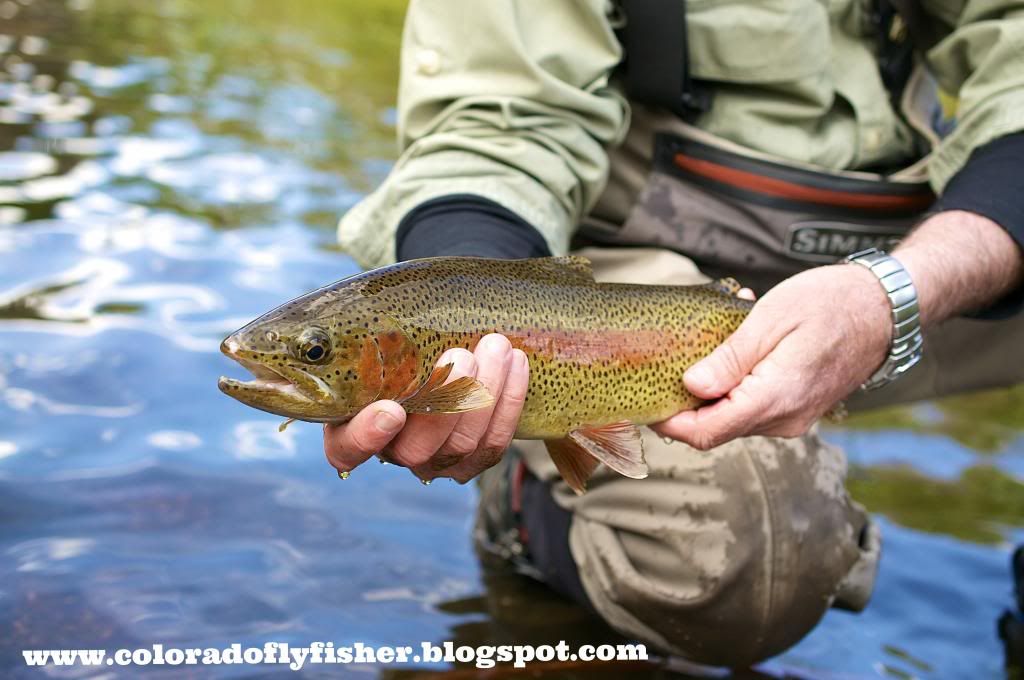
A well fed Pueblo tailwater bow I landed last spring.


My favorite spots to fish below Pueblo are by the Valco Ponds which is a fantastic and underutilized fishery in its own right.  The Ponds have excellent warmwater fishing and still hold the Colorado state record for Spotted Bass at nearly 4lbs 8oz.  There are locals and the typical poachers that target Valco that leave their trash so I always make it a point of leaving with more trash than i showed up with.  From the Valco parking area bend (A $7 day use fee is required) up river past the pump station there is amazing pocket water and deep runs that many different species of fish call home.  Here is a map I put together to show my favorite spots to fish.


View Arkansas River by Valco Ponds in a larger map


Down river from Valco to the Nature Center the rumor is that there are fewer fish but that they are larger.  Brown trout can be found close to 30" in length in some areas.  One of my favorite things about this fishery is that there are more than just trout that call the Pueblo tailwater home.  I've heard stories and seen pictures of walleye, perch, channel catfish, sunfish, crappie, and bass all being landed from the Nature Center up to Pueblo Dam.  And I must admit that one of the bigger fish I hooked last year was a very respectable smallmouth bass that I pulled out of the same run I landed 3 respectable rainbows. 


A popular method to catch different species of fish other than trout is to throw streamers.  White is a great color during fly selection especially if it has a little red.  Don't be surprised if you land a few trout stripping streamers on your quest to catch a bass or walleye.  Good rods to have when fishing the Arkansas River with baitfish and leech patterns are either a 9ft. 6wt. Scott S4, Sage TCX, or Orvis Helios.  Full or intermediate sink tip fly lines help you get your fly down to the fish.  Present it either by casting up stream and across and stripping back, or casting down and across and swinging your streamer to your side of the bank with down stream mends.


Anglers beware during spring runoff the flow rate can reach 2,000-5,000 cubic feet per second.  These high flows are too dangerous to fish from the bank and aren't worth fishing.  Fish are hanging tight up against the bank and the moment you hook one they will take you out in the middle and at that point it's game over.  When the river is up past 300 c.f.s. it can be difficult to wade.  When the flow is in the thousands just standing next to the river can take your breath away.  Late July the flows subside and stay around 400-500 c.f.s. until late October when they drop to 200-300 all of which are very fishable flows.  My favorite time to fish is when the flow is anywhere in the mid 200's.


Directions:  The city of Pueblo is a two hour drive from Denver and slightly less than an hour from Colorado Springs going south on I-25.  Take I-25 south until you get to the highway 50 exit going west.  Go west on 50 to Pueblo blvd, turn left on Pueblo blvd, then turn right on Thatcher.  You will see the Valco ponds and the river on your right. 


Warning:  Pay the fee to get in.  Park rangers are constantly stopping to check that everyone is paid and has their pass in the lower corner of the windshield on the passenger side.  Arriba's mexican restaurant on the corner of Thatcher and Pueblo blvd. has great chilli cheese fries and chicken and steak burritos if you need a pick me up close to the river.  For questions on this spot on the Arkansas River or to request me (Jon Kleis) for a guided on the South Platte River; contact me via email at jonkleisflyfishing@yahoo.com or call and request me at Anglers Covey fly shop at 719-471-2984.


Friday, April 1, 2011

My First Time Czech Nymphing

During Spring, 2012, I spent a day on the upper Arkansas River with Steve Gossage. This was my third time fishing the upper Arkansas in the last five years, so to say I'm new to this huge stretch of water is an understatement, and the few times I've fished it we were tossing around streamers or dry flies. This time the entire day was spent czech nymphing, which was, also, a new experience for me.


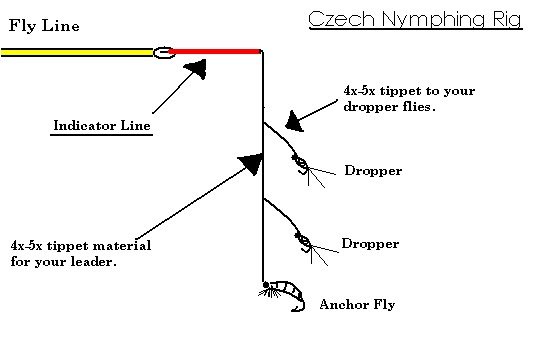
Czech nymphing is a form of flyfishing started by the Polish and refined by the Czechs where the angler doesn't use a typical indicator or split shot. Instead, you use heavily weighted flies to get down to the fish, and a 1 to 2 foot long section of brightly colored monofilament at the end of your fly line which serves as your indicator. Here is my crude sketch of how the rig is set up. Feel free to laugh at your discretion...


On most Czech Nymph rigs you want a fairly heavy fly that serves as your anchor which is attached to the end of a 4-6 foot long 5x straight line leader. The anchor fly does exactly what it's name suggests, in that it gets your flies down, and helps you stay in contact with the bottom. Attach your droppers with 4-5x tippet above your anchor fly at a length that will allow your flies to drift without tangling on each other or your main leader. Twenty inches apart between each dropper seems to be the standard length between droppers from your anchor, or "point fly," up.


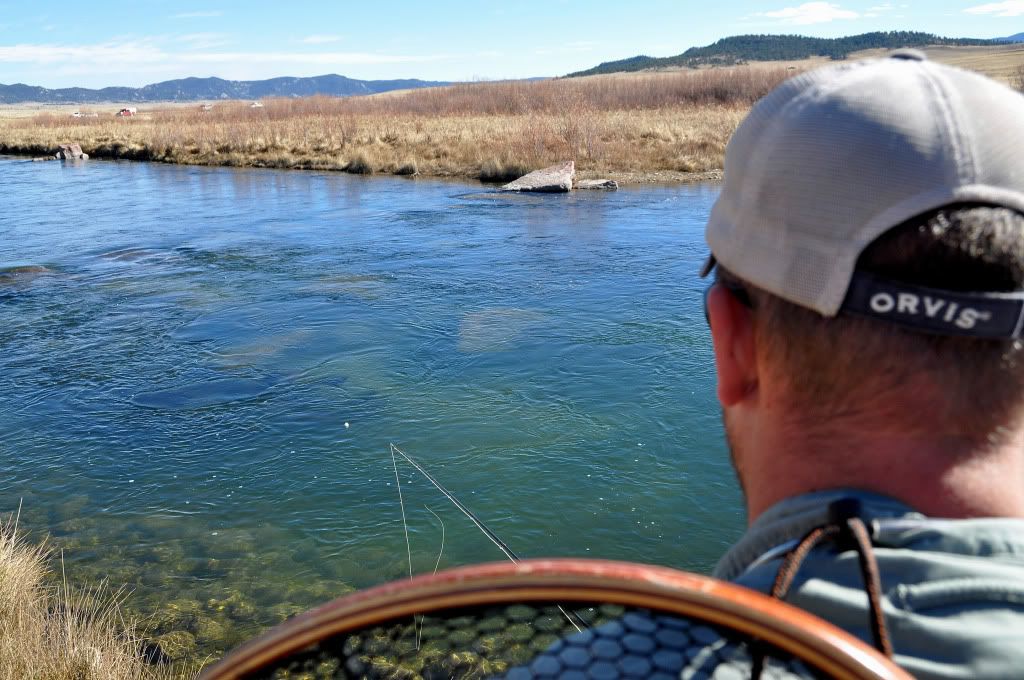
Photo by Kristen Patrocky
One of most important aspects of Czech Nymphing that I quickly discovered is that it's very important to stay in contact with your flies. Keep the rod high and make sure there is no slack in your fly line or leader. Anglers who have spent any amount of time on the water practicing high sticking will pick up the Czech technique quick because they have already spent some time staying in contact with the flies, or at the very least, the indicator through the drift using a standard two fly nymph rig.  When "Czeching" a lot of anglers will actually pull there flies through the drift so that they're moving slightly faster than the current.  Doing so makes it easier to feel the strike.


Staying in contact with your flies and pulling them through the drift can be a bit of a learning curve because most of us have spent all of our time using a strike indicator while trying to get the perfect dead drift. This is the reason that I, ultimately, think fishing with a Czech Nymph rig will make you a better all around nymph fisherman. You'll find that you're more in tune with whats going on beneath the surface, rather than staring a bobber waiting for a sign of life. One of the things I teach my clients is not to rely only on the indicator as your flies drift through the run. Try and keep your eye on the indicator while watching whats going on beneath the surface and trust your instincts.  If you think you saw the fish take your flies or your spider sense so much as tingles then set the hook.


Photo by Kristen Patrocky
Many anglers miss strikes because they are waiting for the indicator to pull under or jump and contrary to popular belief the indicator doesn't move every time the fish takes. In fact the average angler could get up to 5 strikes in a drift without ever being aware of it because they are stuck watching the indicator. A good sign to look for is a flash. When a trout moves on a fly sometimes they turn on their side at an angle where the sun hits the side of their bodies producing a flash that is visible even in deeper pools.

If you're sight fishing to a fish another sign to look for is what I refer to as the wink. The wink is when the trout opens its mouth. The interior of the trouts mouth is white which when opened is easy to spot against the dark bottom of a river. The shape of the trouts mouth when opened kinda looks like the shape of a human eye hence the term. I can't tell you how many hours I've spent hunting for big fish and the only sign I have that a monster trout is in the pool is an occasional wink.


One of the tools for czech nymphing are rods longer than 9 feet though a 9ft 5-6 wt. fly rod will work fine. Longer fly rods are becoming more popular amongst nymph fishermen because the extra length helps you get on top of the fish without having to make long casts that can spook fish by disturbing the water. Longer fly rods also have softer more responsive tips that help anglers detect subtle strikes.

Spools of 4x, 5x, and 6x flourocarben tippet material for building your leaders are a must. If your a fly tyer and you're wanting to tie some Czech nymphs you need spools of various diameter lead wire and tungsten beads to give your flies the weight needed to get down to the fish. To properly build your Czech rig you will also need a spool of highly visible 10-25lb mono fishing line as your indicator line at the beginning of your leader. Stren makes a high viz flourescent green and yellow mono that works great. Rio came out with a weight forward floating fly line that has the last two feet painted red that they call the indicator line which works great as well.

Photo of the Indicator section of a Czech nymph leader


I've said it a million times but what makes flyfishing fun for me is that there is always some new technique or trick you can learn to add to your arsenal that keeps things interesting. My first day fishing with this rig produced 3 nice fish on a stretch of water i'm not really familiar with and all three fish came on new patterns or spin-offs of original patterns that I created to fish this new technique. One fish would have made for a succesful day in my book the rest was just icing.


My first fish Czeching Photo by Jon Kleis
Nobody on this planet would disagree that these kind of experiences are some of the most rewarding in fishing. If you're interested in learning more about this easy new way to nymph fish stop by Anglers Covey Fly Shop (that giant log building on your right as your going west on highway 24 at the foothills of the Rocky Mountains in west Colorado Springs) and I would be more than happy to show you a few tricks and what flies to use and how to get set up.


For any other flyfishing related questions or to set up a guided trip and have an adventure in Colorado shoot me an email at jonkleisflyfishing@yahoo.com or go to www.anglerscovey.com and go to the hire a guide section and request me (Jon Kleis) in the special requests box when your setting up your trip.


Tuesday, March 15, 2011

How To Land A Big Fish In Small Water

Colorado has been building a reputation with anglers acrossed the country as a prime fishing destination and for good reason. We have amazing tailwaters, spectacular stillwater fisheries, and freestone rivers galore. However, what we call rivers here in Colorado most people from other states call streams or creeks. The South Platte River is a prime example of what we call a river versus what other people call the same. Make no mistake our small water does not limit the size and quality of the fish we catch in our great state.


To catch big fish first you must find big fish. There is a common misconception amongst anglers that the really deep pools in our favorite rivers that seem dead must have a massive alpha male world record trout of our dreams swimming somewhere in its midst. Why else do we not see an entire school of fish feeding in that crystal green pool of perfection? It is because fish hang out together in schools or pairs even in rivers, and most of the time big fish enjoy the company of other often times smaller fish.


This underwater photo of paired up trout was taken after a client of mine
landed three from this exact same spot. All three landed fish were smaller
than these two.


Trout are predators so it makes sense that a trout with a mouth large enough to eat another would want to be where the food is at. There are exceptions to that rule like when fry congregate in schools along banks, or when there is an occasional man eating brown trout staking claim in a deep pool that is potentially scaring off anything that stands to get eaten. Water temps play a big role in where you will find fish. Brown trout are a sturdier fish and can handle warmer conditions and stagnant water better than other trout species. The truth is that the majority of trophy fish I've landed were hanging out with an entire school of fish half their size. In some cases the trophy fish are either a short distance up stream or down stream in the same run as their smaller counterparts, or they were staying closer to the bottom directly underneath the school.


Once you have figured out where to find big fish, and have figured out how to fool big fish, then it becomes time to do what is necessary to land big fish. One of the advantages to going after fish in small water is that there is limited space for the fish to run.  Large rivers and lakes provide plenty of room for fish to go as they please giving them the advantage during the fight.


Let me paint you a picture... A second year flyfisher hooks and looses the fish of his dreams which is something he has done a few times up to this point. Losing the fish of his dreams is something he will continue to do for the rest of his life. Every fish that manages an escape and is rarely seen during the fight will always be the fish of a lifetime.


After setting the hook the angler has the big fish on and the beast attached to the end of his line makes a mad dash up river ripping line off the now stunned and completely stationary sophomore rookies reel. The fisherman tries to put pressure on the fish in an attempt to slow it down during the middle of the first explosive run. The line breaks. The angler adds copious amounts of water to the river in the form of tears. Knees still locked and legs shaking he is totally defeated but instantly ready for round two because flyfishers are notorious gluttons for punishment.


A few more years of due paying later lets paint a different picture... The five year angler has added a few new tricks up his sleeve which he has picked up from years of having his butt handed to him by big fish, and by reading articles full of helpful advice in magazines and blogs such as this. My first tip for landing big fish is to do two things after the hook set. Give the fish line while it runs, and do your best to stay with the fish. If it runs up river you run up river and vice versa should it run down. If you are staying parallel with the fish and keeping steady pressure you're well on your way.


When the fish makes another run give line and go where it goes playing catch up until your back on top of the fish. Do not stand there and let the fish run. The point I want to hammer home is that it is very important for you to be loose and mobile the moment you feel weight on your line. Trust me there is a learning curve to this. It is not easy after years of standing in one spot trying to horse the catch to you to change it up and start running with the fish right after the hook set. Note: You will fall on your face. You will get wet. You might even take a branch or two to the eye. It is worth it.


Now you have survived the first couple of runs so the next step is to get yourself into a position downstream from the fish where you can do two things. First, have easy access to the bank in case you need to be mobile again if the fish runs. The second thing that is equally as important is that you find a place to land the fish without any obstacles close by for the fish to snag you on (such as logs and undercut rocks).


It is very important that you stay directly behind the fish as you are fighting it from down stream. The purpose to fighting the fish from this position is to use the current to tire it quicker. Another very important reason to fight your catch from a downstream position is that when trophy fish get tired they turn down stream as a last attempt to get free using the same current you were just using as leverage against you. If you're fortunate enough to have that happen while you are ten feet or closer down stream and are lined up directly behind the fish your odds of landing that trophy increased two-hundred percent.

Try to keep the rod tip up without jerking the rod. When the trout turns it will hopefully be head up without much fight because it is trying to catch its breath. Before the fish turns and it attempts a last run down stream it's a good idea to have the net in the water and in position. The motion of putting the net in the water after the fish has turned will spook it and cause it to change direction which means you're chasing it down to try again.


Here's your recap... To catch big fish you have to go where fish are and look for big fish. Run where the fish runs. Once the fish gets tired position yourself downstream and directly behind the fish so that it is fighting you and the current, but also so you're in postition to net the fish head first when it turns down stream.


When it comes to fishing there are very few things that I guarantee except this. Spend a lot of time on the water looking for big fish where there are other fish, and have faith in these tips and techniques and your average fish length will increase with every big catch. Without question there is something special about catching trophy trout out of water most people wouldn't expect to hold big fish. Most important don't forget to bring your camera so you have plenty of pictures or video to show non believers. "You landed an 18 inch rainbow out of upper fountain creek?!" It happens to somebody. Tight Lines!


Monday, January 17, 2011

Tailwater Fly Fishing

When I think of tailwater fly fishing I picture rocky canyons, big fish, small flies and cold winters.  A tailwater is anywhere a river comes out beneath a bottom-release dam.  Rivers like the South Platte can have several lakes or reservoirs along its drainage, all of which can provide very different fly fishing experiences. 

  Photo by Jon Kleis
During the peak of winter, most lakes and reservoirs only have a few feet of ice on the surface. This means that the water coming out below the dam can be a few degrees above freezing, even during Janurary. The water conditions this time of year are low and clear, but the fishing can be very productive if you manage to get on the water during a warm day with a good hatch.  Colder temperatures limit the type of bugs that can hatch, which makes fly selection simple.  Fly selection is limited to small baetis (bwos) on the overcast days from October-December and March-June, and extremely small midges.

Good winter patterns are: Kleis's Mid-Drift Midge size 22, gray RS-2s size 22-24, Dorsey's Top Secret midge size 22-24, Black Beauties size 22-26, Parachute Adams size 24-26, Apricot Glow Bugs size 16, San Juan worms size 16, and for some tailwaters, Mysis Shrimp patterns like Sand's Epoxy Mysis size's 16-18.   


Kleis's Mid-Drift Midge in Olive

Tailwaters also provide great fishing opportunities in the summer months, and in states that normally would'nt have water cold enough to hold trout. During the summer, water at the bottom of these reservoirs stays cooler because of the lack of exposure to sunlight.  Rest assured, if there is a bottom-release reservoir -even in states as hot as Texas- the odds are good that at least part of the year the river below holds trout.


As far as insects go, the bugs that can be found are as diverse as the types of tailwaters they live in.  Even during winter there are more than just midges and baetis available.  There are also stonefly nymphs, caddis larvae, annelids, crane fly larvae, leeches, and terrestrials such as scuds and crawfish. Baetis, midges, and small stoneflies are typically the only two insects that are comfortable hatching in temps associated with winter fishing, so that is what the trout focus on. Stonefly nymphs don't go through an emergence stage like a mayfly nymph, so unless there are a ton of stonefly nymphs on the move, trout might not be conditioned to seeing and eating them. Trout have to see the bug in order to eat the bug. Try using a small stonefly pattern as your lead fly on a 2 fly nymph rig, but if you see it spooking trout, or that it's not producing, switch to 22's-26's. 

Stonefly found during winter photo by Jon Kleis


In the spring fish are looking up for caddis and baetis that are either emerging, or resting on the surface as adults. Fish also move into shallower and faster feeding lanes as a result of run-off, and the rainbow/cutthroat spawn. 


Avoid casting to fish that you can tell are actively spawning on a gravel bed. Instead, target the back of spawning beds in an attempt to pick up fish that are feeding on eggs. Because trout spawn, or stage in shallow and well oxygenated water, my strike indicator is set shallow so I don't drag on the bottom. This increases my chances of detecting a strike sooner, and reduces my chances of foul hooking fish. 

You will know after a few casts if a fish is feeding, or has something else on its mind. Land the fish as quickly as possible and handle the fish as little as possible. Always keep the fish and the net in the water after landing your catch. Another great way to fish the spawn is to find fish as they migrate.  Migrating fish are eager takers and are still exposed in fast, and shallow water.

Starting in late-spring/early-summer a good all around PMD nymph imitation to use is the Pheasant Tail nymph.  A good way to fish when trout aren't actively feeding on the surface is to use a tandem nymph rig under a strike indicator.  I like to use a Pheasant Tail as my first fly, and with 5x tippet tie about a 15 inch section of leader material from the bend of the Pheasant Tail hook to a size 22 or smaller gray RS-2.  Roughly 8-10 inches in front of the Pheasant Tail clamp a #1 or #4 split shot to help your flies get down.  

Adjust your indicator according to the depth of the water your fishing in, so you're presenting your flies to the fish in their feeding zone where they can see it.  Now you're covering two bases (PMDs and BWOs) which doubles your odds of fooling different fish that could be focusing on two completely different hatches.  Make sure to check with your states regulations before you fish tandem rigs because its illegal in some states.

Photo by Daniel Zimmerman

Early Summer means fish are now looking up for sparse caddis hatches along with stoneflies such as the Yellow Sally Stonefly, as well as emerging and adult PMDs.  Good dry fly imitations for stonefly hatches are the Headlight Yellow Sally, and Stimulators.  Fish are also looking for terrestrials like hoppers, ants, and beatles.  As far as nymphs are concerned, try a Lafontaine's Sparkle Pupa behind a tan-colored San Juan worm.  Late summer signals the start of the Trico mayfly hatch in many tailwaters.  Depending on the river and it's biomass, the trico hatch itself can be huge, and trout feed like ravenous sharks as the bugs die and fall to the water in what's called a "spinner fall."

Late summer and fall is by far my favorite time of year to fish.  In the morning, anglers are casting small trico dry flies.  Midday, have on some form of bouyant hopper with a drowned trico or small black RS-2 as a dropper.  During the afternoon/evening, caddis and sparse baetis hatches are back on the menu.  In my humble opinion, outside of the Mother's Day Caddis hatch, fall is the best time of year to fish with dry flies.


As the water cools and the days shorten, brown trout are staging to spawn, making them accessible to anglers.  Land-locked Sockeye salmon called Kokanee start their spawning migration, also.  Egg patterns, Copper Johns, and small olive baetis droppers are great flies to use in tandem if you decide to fish close to the bottom.

Tailwaters are so loaded with bugs and nutrients trout can grow up to 2-6 inches per year depending on the amount of fishing pressure, size of the river, and how much protein-rich food they have access to.  Some rivers have an abundance of shrimp such as the Mysis or Scud Shrimp and when trout key in on these two freshwater crustaceans they grow even faster, and have the most amazingly vibrant colors found on trout anywhere in the world.


Elevenmile Canyon photo by Daniel Zimmerman
Huge trout and scenery like this are what keeps most anglers coming back to these fisheries.  If I had to choose one type of water to spend my entire life fishing, forsaking all others, it would be a tailwater.  This is a place where you can challenge yourself to become a better angler, and have a chance to land the fish of a lifetime.  To request a guided trip with me on the South Platte shoot me an email to jonkleisflyfishing@yahoo.com


Contact Form

Name

Email *

Message *